If you wish to stop receiving our emails or change your subscription options, please Manage Your Subscription
The Better Fundraising Company, P.O. Box 1563, Edmonds, WA 98020, US
.webp)
Opening now...

Elia T is sharing this email thread with you using Streak Share.

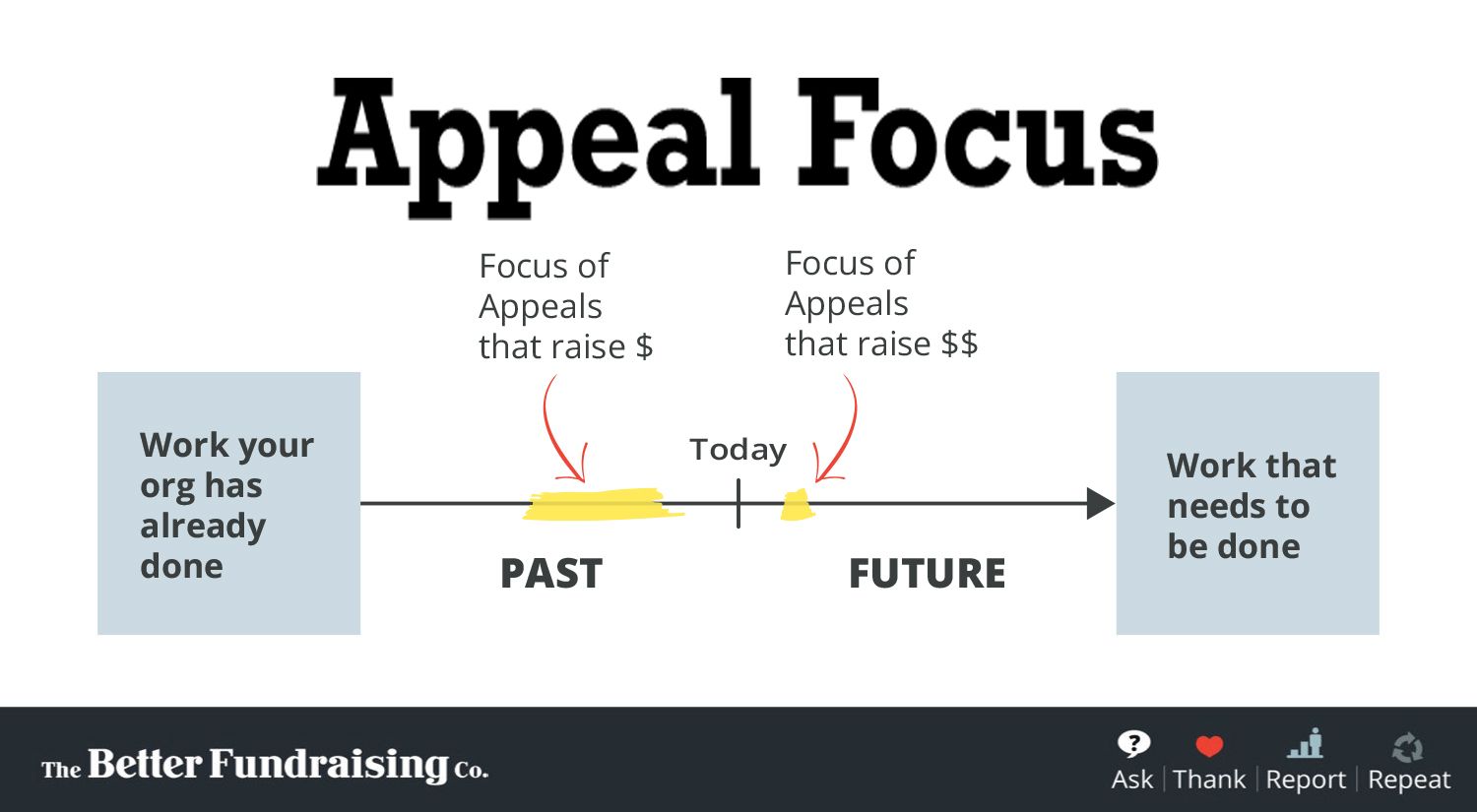
The graphic above has been sitting in a folder on my computer for months because I’m not quite happy with it.
But I’m following my own advice and “sending it out even if it isn’t perfect.” I think it can help you raise more money this fall, and a lot of organizations need all the help they can get right now.
Here’s the Big Idea; focus your appeals on the near future, not on the past.
To use the language I used in the graphic; you will raise more money if you focus your appeals on “work that needs to be done soon.” You will raise less money if you focus your appeals on “work your organization has already done.”
Weirdly, nonprofits tend to relentlessly focus their fundraising on the past. They share stories of people they have already helped. They share statistics and lots of numbers from their past work. They talk about the approach they’ve used.
I believe this comes from a good place – it’s an attempt to prove to donors that the organization knows what it’s doing and is effective.
But what I’ve seen from looking at fundraising results for 30 years is that individual donors send in more money when the focus of the appeal is on the near future, not on the past.
When you ask your individual donors to fund meaningful work that needs to be done soon, I think three things are happening:
But really, even just those three bullet points overcomplicate things.
It’s as simple as this little story … put yourselves in the shoes of a busy individual donor. She’s at home, has a couple minutes, and is going through her mail or email. She feels like making a gift. Which appeal do you think she will give to:
Individual donors making quick decisions seem to be wired to support work that they care about that needs to be done soon.
So focus your appeals on the near future – usually between the day you send it and about 8 weeks from then. Focus on meaningful work/service/help your organization plans/hopes to do in the next month or so. Ask your donors to send in a gift to help fund that work.
Save the focus on the past for when you are reporting back to donors. Or when you are making a case to a Foundation for why they should give you a grant.
If our experience is any indication, you’ll be so pleased at how much money your appeals raise that you’ll never go back to focusing your appeals on the past.



This email link is not publicly discoverable, and is only shared at the discretion of the sender.


Install successful
Waiting for install...